
Project overview
The Cullompton Flood Compensation Scheme was awarded through Devon County Council’s Minor Engineering Works Framework. Associated Asphalt acted as Principal Contractor for the creation of two flood compensation areas to the east of the M5 motorway at Cullompton.
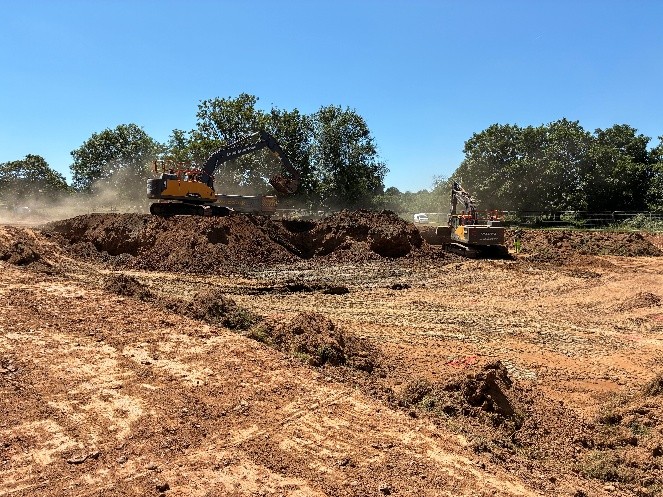
The works involved excavating 10,000m³ of soil across two areas to replace floodwater storage capacity lost as a result of the construction of a new relief road.
The challenge
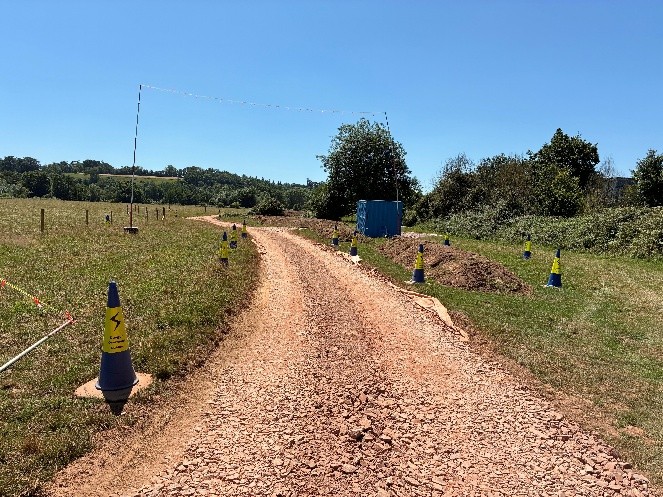
The site’s proximity to the M5 motorway and local properties required careful management of the works. The presence of 11kV overhead cables crossing the haul road also required close liaison with the Environment Agency, National Highways, National Grid and other key stakeholders.
Heatwaves created exceptionally dry ground conditions, generating significant dust during excavation. Controlling dust without saturating the site was essential to limit the impact on the motorway and neighbouring properties.
Our approach
Associated Asphalt liaised closely with the Environment Agency and other key stakeholders throughout the project to coordinate works near the motorway and overhead services.
To manage the dry conditions, the team implemented a water suppression regime, keeping the soil damp enough to reduce dust levels without saturating the site. Close working with the haulage provider also enabled all excavated soil to be diverted from landfill.
Scope of works
The scope included:
- Installation of 1,158m of stock fencing and Heras fencing
- Construction of a new 670m haul road from Old Mill Road to the work location
- Excavation and removal from site of 10,000m³ (20,000 tonnes) of soil
- Reinstatement of 300mm of existing topsoil and reseeding on completion
- Removal of the haul road
- Removal of fencing once the seed had established
Value engineering and innovation
Working closely with the haulage provider, the team identified alternatives to landfill for the significant quantities of excavated soil. All soil removed from site was directed to a combination of U1 sites, RPS91 sites and licensed facilities, with none taken to landfill.
Safety, quality and social value
Stakeholder liaison was a key part of managing the works alongside the M5 motorway and beneath the 11kV overhead cables crossing the haul road. Dust suppression during excavation helped reduce dust pollution affecting the surrounding environment, motorway users and local residents.
The use of U1 sites enabled soil removed from the project to support local farm and forestry construction projects, offering social benefits to the local area.
Outcome
The scheme created two compensation areas to replace floodwater storage capacity lost through the construction of the new relief road. The works combined large-scale soil excavation with topsoil reinstatement and reseeding, while diverting all excavated soil away from landfill.